
LEGO Technic Sets by Number and Type
Identify selected models, parts packs and regional counterparts. Catalog scope changes the total: BrickEconomy has 574 records, BrickLink 603 and ToysPeriod 656.
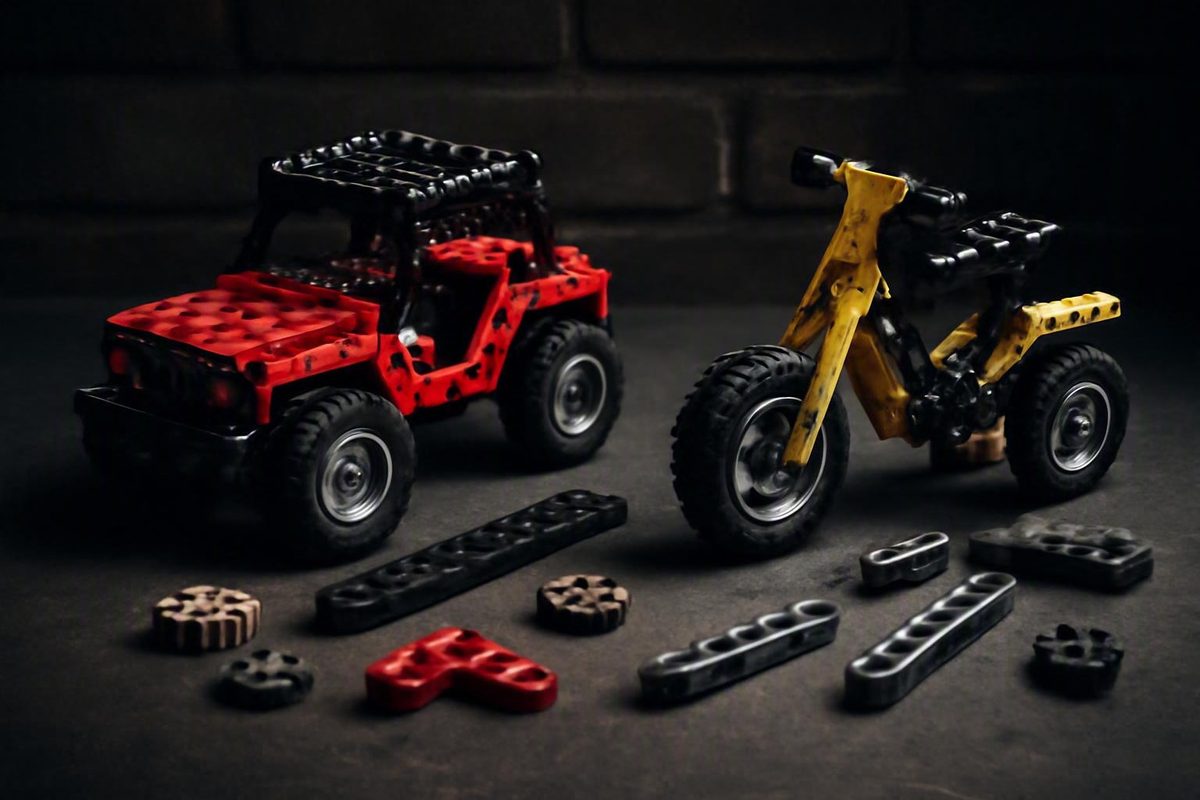
A LEGO set number is usually the best starting point for identifying a Technic model, but it is not always the whole answer. Early products may have different European and US numbers, catalogs may use alternate names, and broad Technic indexes may include anything from a complete vehicle to a motor or beam pack.
This is a sourced selection of documented LEGO Technic and historically related numbers, not a complete historical catalog. Its strongest coverage is the early European and US ranges, selected accessories and four-digit products, and a captured selection of modern five-digit sets. It is intended for identifying loose parts, incomplete secondhand sets, old instructions, or listings with uncertain names.
How to use this numbered Technic lookup
If you have a number from a box, instruction booklet, sticker sheet, motor, or seller’s listing, begin with the exact digits. Then compare six fields:
- Printed set number: The number visible on the packaging or instructions, when known.
- Database identifier: Third-party catalogs may display an identifier such as
850-1. - Set name and aliases: Names can vary by region, punctuation, translation, or catalog convention.
- Release year: Check the year independently rather than assuming numerical order is chronological.
- Product type: Determine whether the entry is a model, accessory pack, motor, promotion, or adjacent Technic-related product.
- Alternate or regional number: Some early European models have documented US counterparts.
Use these jump points to reach the relevant range:
- Pre-Technic and early European numbers
- Early accessories and power products
- European and US equivalents
- Selected four-digit products
- Selected modern five-digit sets
- Catalog conflicts
- Verification workflow
When a database shows 850-1 rather than 850, treat the suffix as part of that database’s identifier unless packaging evidence establishes otherwise. BrickLink and Brickset use the -1 form in their records, but the supplied evidence does not establish that the suffix appeared as part of the original printed retail number.
Do not assume that a larger number means a later set. The supplied indexes place different markets, product types, promotions, and related lines in different ranges. The release-year field must therefore be checked separately.
Names also require flexible searching. If 850 Fork Lift produces no useful result, try 850 Fork-Lift Truck and 850 Fork Lift Truck. For 853, search both Car Chassis and Auto Chassis. A number-first search narrows the field; alias matching helps reconcile catalog wording.
A current retail page must also be distinguished from a historical database. The captured official US shop page reported 63 Technic products but exposed complete details for only 18 of them. That count represented the shop page at the time of capture, not a historical total of all Technic products.
What counts as a Technic set in this guide?
The core lookup consists of numbered models classified by the consulted catalogs as Technic or as part of its Expert Builder predecessor. Because historical sources draw the boundaries differently, related products are retained but labeled rather than silently treated as conventional Technic models.
The labels used here are:
- Core model: A numbered vehicle, machine, chassis, or other primary build classified as Technic or Expert Builder.
- Accessory or parts pack: Beams, gears, pistons, steering components, bands, wheels, or similar supplementary inventory.
- Motor or power pack: A motorized or electrical component package rather than a stand-alone vehicle model.
- Promotional item: A product distributed or classified as a promotion.
- Adjacent Technic-related product: An item indexed beside Technic because of its construction system, parts, or historical association, without implying that it necessarily carried Technic branding.
BrickEconomy describes the line as beginning under the Expert Builder name in 1977 and being renamed Technic in 1984. It also reports 574 records under its own current scope. Both are third-party database claims, not official historical documentation or an official count from LEGO. BrickEconomy describes its Technic history and catalog scope here.
The category boundaries remain unsettled. Brickipedia explicitly excludes BIONICLE from its Technic list, while ToysPeriod places Bionicle, Racers, Star Wars, Expert Builder, and other groups inside a broader Technic-related category structure. Brickipedia also labels its own list incomplete. Brickipedia’s exclusion and incompleteness notes illustrate the narrower approach.
The archived Technica index takes a broader historical approach. It groups pre-Technic entries, European Technical sets, US Expert Builder products, promotions, Mindstorms and Spybotics, Power Packs, Technic Star Wars figures, RoboRiders, and Universal sets. Those headings help with discovery, but they do not prove that every indexed item was sold with Technic branding. The archived “Set Index by Number” shows this broader classification.
BrickEconomy reports 574 records, BrickLink reports 603, and ToysPeriod reports 656 under their respective scopes. None should be described as LEGO’s official total. One database may include supplementary packs and adjacent themes that another excludes or categorizes separately.
For that reason, this guide separates adjacent lines and supplementary products from core models. Inclusion means that an item is useful in a number-first Technic lookup, not that every corresponding box carried the same branding.
Pre-Technic and early European sets by number
The archived Technica index places three products in a “pre-Technic” group. No release years are assigned here because the supplied historical evidence does not provide them.
| Number | Documented name | Year | Product type |
|---|---|---|---|
| 001 | Gear Set | Not established | Pre-Technic gear set |
| 801 | Gears and Bricks | Not established | Pre-Technic construction set |
| 810 | Big Working Model Set with Gears and Heavy Tyres | Not established | Pre-Technic model set |
These names and classifications come from the archived number index cited above. Because it is a third-party historical index, “pre-Technic” should be treated as its research category rather than a definitive ruling about original branding.
Early European models, 850–856
| Number | Documented name | Year | Product type | Alternate wording | Documented US counterpart |
|---|---|---|---|---|---|
| 850 | Fork Lift | 1977 | Core model | Fork-Lift Truck; Fork Lift Truck | 950 |
| 851 | Tractor | 1977 | Core model | — | 952 |
| 852 | Helicopter | 1977 | Core model | — | 954 |
| 853 | Car Chassis | 1977 | Core model | Auto Chassis | 956 |
| 854 | Go-Kart | 1978 | Core model | Go Cart; Go-Kart | 948 |
| 855 | Mobile Crane | 1978 | Core model | — | 955 |
| 856 | Bulldozer | 1979 | Core model | — | 951 |
Brickset documents the names, years, and European-version relationships for 850 through 855 and identifies 856 as the 1979 Bulldozer. Its early Technic catalog provides the source-specific records used here. The 856/951 relationship is addressed separately in the regional cross-reference below.
This table deliberately omits piece counts. The major catalogs disagree about the inventories of several early models, especially sets 850 through 853. Those figures are compared source by source in the catalog-conflict section rather than collapsed into an unsupported consensus.
Continuing models, accessories, and power products
The early number sequence did not consist only of vehicles. It also included beam packs, mechanical components, power products, and a motor.
| Number | Documented name | Year | Product type | Alternate wording or note |
|---|---|---|---|---|
| 857 | Motorcycle | 1979 | Core model | — |
| 858 | Auto Engines | 1980 | Model or mechanical demonstration set | — |
| 870 | Power Pack | 1977 | Motor or power pack | Not a vehicle model |
| 871 | Expert Builder/Gear Parts | 1977 | Accessory or parts pack | Gear-parts pack |
| 872 | Two Gear Blocks | 1978 | Accessory or parts pack | Gear Reduction Kit |
| 874 | Yellow beam pack | 1979 | Accessory or parts pack | Color-specific beam assortment |
| 875 | Red beam pack | 1979 | Accessory or parts pack | Color-specific beam assortment |
| 876 | Blue beam pack | 1979 | Accessory or parts pack | Color-specific beam assortment |
| 877 | Steering Gear Parts | 1979 | Accessory or parts pack | Steering components |
| 878 | Piston Parts | 1979 | Accessory or parts pack | Axles & Pistons |
| 879 | Gear Wheels with Chain Links | 1979 | Accessory or parts pack | Gear-and-chain assortment |
| 880 | 12V Motor | 1979 | Motor or power pack | Electrical component set |
BrickLink supplies the names and dates in this table and lists these models, parts packs, and power products together in its Technic reference category. The BrickLink catalog documents the sequence from 857 through 880.
The number alone therefore cannot establish that an item is a complete construction model. A secondhand lot described as “Technic set 877” should be evaluated as a steering-parts package, not as an unidentified vehicle with missing instructions.
European Technical and US Expert Builder number equivalents
Some early models were documented under different European and US numbers. “Counterpart” is the safest general term: the sources support the relationships below, but they do not establish that every alternate number elsewhere in Technic history represents a regional edition.
| European number and name | US number and name | Identification note |
|---|---|---|
| 850 — Fork Lift / Fork-Lift Truck | 950 — Fork Lift | European 850 is documented as the counterpart of US 950 |
| 851 — Tractor | 952 — Farm Tractor / Tractor | Name varies by index |
| 852 — Helicopter | 954 — Sky Copter | US title differs substantially |
| 853 — Car Chassis / Auto Chassis | 956 — Auto Chassis | “Car” and “Auto” vary by catalog |
| 854 — Go-Kart | 948 — Go Cart / Go-Kart | Spelling and hyphenation vary |
| 855 — Mobile Crane | 955 — Mobile Crane | Same basic title |
| 856 — Bulldozer | 951 — Bulldozer | Pairing appears in the archived index; BrickLink also identifies both numbers as Bulldozer entries |
The archived Technica index supplies all seven pairings, including 856/951. Brickset independently describes 850 through 855 as European versions of 950, 952, 954, 956, 948, and 955 respectively. The archived index provides the complete early cross-reference used in this table.
This table is useful when a seller has US instructions but describes the model under a European number found in another database. Search both numbers, but preserve the distinction in collection records. An instruction booklet marked 954 should remain cataloged as 954 rather than being silently relabeled 852 merely because the underlying model has a documented counterpart.
Two US supplementary products also appear in the early sequence:
| US number | Documented name | Year | Product type |
|---|---|---|---|
| 960 | Power Pack | 1978 | Motor or power pack |
| 961 | Expert Builder/Gear Parts | 1978 | Accessory or parts pack |
Their shared names make 960 comparable to 870 and 961 comparable to 871, but the supplied evidence does not establish a precise one-to-one regional relationship. They are therefore listed as US supplementary entries without a stronger equivalence claim.
The practical rule is simple: use an alternate number only when a source documents the relationship. Similar names, matching counts, or neighboring number ranges can suggest a connection, but they do not prove regional equivalence.
Selected four-digit Technic-related numbers
Four-digit numbers cover a large and varied portion of Technic history. The following entries are selected examples supported by the available excerpts, not a complete survey of the 1000s through 9000s.
Selected accessories, promotions, and system products
| Number | Documented name | Year | Pieces shown | Product type |
|---|---|---|---|---|
| 1148 | Differential | 1981 | 5 | Accessory or parts pack |
| 1237 | Asimo Robot | 2001 | 56 | Promotional or adjacent product |
| 1267 | Shock Absorbers | 1985 | 4 | Accessory or parts pack |
| 1455 | LEGO Programmable Systems Pack (BBC Version) | 1992 | Not provided | Adjacent programmable-systems product |
| 5206 | Speed Computer | 2000 | 28 | Accessory or electronic product |
| 5210 | Elastic Bands | 1997 | 1 | Accessory or parts pack |
| 5219 | Silver Wheel Multi Pack | 2000 | 28 | Accessory or parts pack |
These are Brickipedia’s third-party catalog values. The blank count for 1455 means only that the supplied record did not provide a value; it does not establish that the product contained no pieces. Brickipedia presents these entries within its explicitly incomplete Technic list.
Classic-model identification table
This selection covers recognizable four-digit models released between 1980 and 2003. It can help identify old instructions or models commonly discussed without their numbers.
| Number | Documented name | Year | Product type |
|---|---|---|---|
| 8455 | Back-Hoe | 2003 | Core model |
| 8480 | Space Shuttle | 1996 | Core model |
| 8485 | Control Centre II | 1995 | Core model with control system |
| 8838 | Shock Cycle | 1991 | Core model |
| 8860 | Auto Chassis | 1980 | Core model |
| 8862 | Backhoe Grader | 1989 | Core model |
| 8865 | Test Car | 1988 | Core model |
| 8868 | Air Tech Claw Rig | 1992 | Core model |
| 8880 | Super Car | 1994 | Core model |
ToysPeriod documents 8838, 8860, 8862, 8865, 8868, and 8880 in its visible database records. Its Technic reference provides those six number, name, and year matches. A Eurobricks forum compilation of Brickset ratings supplies the visible number-and-year matches for 8455, 8480, and 8485; it is used here only for identification, not as an objective ranking of set quality. The forum compilation lists those three classic models and their years.
The disputed 3038/8266 identification
Bricks Stack Exchange community answers identify the same pictured builds as 3038 Super Challenge and, in another answer, 3038/8266 Super Slayer/Super Challenge. The identification is useful as a search lead, particularly for a model containing a turquoise Technic figure, but it remains community-supplied information.
The evidence does not provide an official explanation for why both 3038 and 8266 are reported, whether they represent regional packaging, or which title is canonical. The community discussion preserves the competing names and numbers.
Other four-digit ranges in the archived index
The archived Technica page also groups:
- Promotional products within four-digit ranges
- Mindstorms and Spybotics entries around the 3800 range
- Power Packs in the 5200 range
- Technic Star Wars figures and RoboRiders from 8000 through 8012
- Universal sets beginning at 8020
These headings are discovery aids, not a basis for inferring every missing number or treating every product as a core Technic model. The supplied 2006 archive text ends partway through the Universal Sets section, so expanding it into an apparently complete range would overstate the evidence.
Selected modern five-digit Technic sets by number
For current and recent five-digit products, the official LEGO US shop is the strongest supplied source for product wording, age recommendations, piece counts, and listed US prices.
The table contains the 18 products visible in the supplied shop excerpt, not all 63 products the page reported. Every price is a time-sensitive listed US price, not a permanent price, worldwide price, or resale value. Product wording, piece counts, ages, and prices come from the official LEGO US Technic listing.
| Number | Official product wording | Pieces | Age | Captured listed US price |
|---|---|---|---|---|
| 42172 | McLaren P1 | 3,893 | 18+ | $449.99 |
| 42206 | Oracle Red Bull Racing RB20 F1 Car | 1,639 | 18+ | $229.99 |
| 42207 | Ferrari SF-24 F1 Car | 1,361 | 18+ | $229.99 |
| 42210 | 2 Fast 2 Furious Nissan Skyline GT-R (R34) Car | 1,410 | 18+ | $139.99 |
| 42223 | 1966 Ford GT40 MKII Race Car | 793 | 18+ | $74.99 |
| 42224 | Porsche 911 GT3 R REXY AO Racing Car | 1,313 | 11+ | $149.99 |
| 42228 | McLaren MCL39 F1 Car | 1,675 | 18+ | $229.99 |
| 42229 | Fast and Furious Mitsubishi Eclipse Car | 827 | 14+ | $64.99 |
| 42231 | Fast and Furious Dodge Charger R/T Car | 1,516 | 18+ | $159.99 |
| 42232 | Koenigsegg Sadair’s Spear Megacar | 4,104 | 18+ | $449.99 |
| 42233 | Mighty Machines | 44 | 7+ | $4.99 |
| 42234 | Dodge Viper GTS-R Sports Car | 805 | 10+ | $64.99 |
| 42235 | Ferrari 488 Pista Car | 882 | 9+ | $64.99 |
| 42236 | Custom Garage Ford Mustang GT Car | 973 | 10+ | $99.99 |
| 42238 | Ducati Desmo450 MX Factory Motorcycle | 457 | 10+ | $49.99 |
| 42239 | Batmobile Tumbler | 719 | 12+ | $189.99 |
| 42240 | Aston Martin Aramco AMR25 F1 Car | 1,547 | 18+ | $229.99 |
| 42241 | Green Bugatti Chiron Pur Sport Hypercar | 771 | 9+ | $64.99 |
Availability must be checked again before buying. The captured excerpt specifically marked 42233 Mighty Machines as new and on backorder, but that does not establish its status after the verification date. The absence of an availability note for another row likewise does not prove that the product remains in stock.
Official wording should generally take priority in a current product record. A third-party catalog may shorten a licensed title or rearrange words such as “Mustang GT.” Preserve the official wording as the primary title and store the shortened form as an alias rather than creating two apparent sets.
Why names and piece counts differ between catalogs
The set number is often the strongest reconciliation key because names are especially vulnerable to punctuation, regional wording, abbreviations, and editorial conventions.
Two early examples show the problem:
- 850: Fork Lift, Fork Lift Truck, or Fork-Lift Truck
- 853: Car Chassis or Auto Chassis
These differences do not necessarily indicate separate models. When the number, year, and documented counterpart align, alternate wording is usually best stored as an alias. Even so, preserve the exact source wording when documenting a collection or comparing inventories.
Piece counts require more caution:
| Set | BrickLink | Brickset | ToysPeriod | Status |
|---|---|---|---|---|
| 850 | 207 parts | 210 pieces | 214 pieces | Disputed |
| 851 | 305 parts | 318 pieces | 320 pieces | Disputed |
| 852 | 362 parts | 364 pieces | Not shown in supplied excerpt | Disputed |
| 853 | 602 parts | 601 pieces | 619 pieces | Disputed |
| 854 | 206 parts | 206 pieces | 206 pieces | Agreement among supplied values |
| 855 | 512 parts | 512 pieces | Not shown in supplied excerpt | BrickLink and Brickset agree |
BrickLink supplies the 207, 305, 362, 602, 206, and 512 figures in its records. Brickset reports 210, 318, 364, 601, 206, and 512. ToysPeriod reports 214, 320, 619, and 206 for the applicable visible entries. The ToysPeriod reference preserves its source-specific early counts.
No unsupported winner should be selected. Inventories and classification practices may differ, but the supplied evidence does not establish the exact reason for each discrepancy. Possible explanations should not be promoted to facts without examining the underlying inventories and their counting rules.
A reliable catalog record would instead preserve the disagreement:
Set 850 — piece count disputed: BrickLink 207; Brickset 210; ToysPeriod 214.
That format lets a buyer compare physical contents against the particular inventory being used. It also prevents one database-dependent value from appearing universally settled.
The same caution applies to terminology. “Parts” and “pieces” may be used differently across sites, but the evidence does not prove that the wording alone causes the numerical differences. Preserve the source label, retain attribution, and use a disputed-data flag until a consistent official or archival inventory can be verified.
Source limits and how to verify an unidentified set
No single supplied source answers every historical question.
The official LEGO shop is the strongest source here for the current products it displays, including official wording, age recommendations, piece counts, and captured US prices. It is not a complete historical archive.
BrickLink, Brickset, Brickipedia, BrickEconomy, ToysPeriod, and the archived Technica page are third-party historical references. They are useful for number sorting, aliases, release years, regional counterparts, and old supplementary products, but their scopes and inventories differ.
The archived Technica capture is dated May 13, 2006, so it cannot document later releases. Its supplied text is also truncated partway through the Universal Sets section. Brickipedia labels its list incomplete, while other supplied database extracts expose only a page or part of a page. These limitations are why this article provides selected tables rather than claiming historical completeness.
A practical verification workflow
When a number is missing or disputed:
- Search the exact printed number. Begin with the digits visible on the box, instructions, sticker sheet, component, or seller’s photographs.
- Try the database form. If
850produces weak results, search850-1, but do not assume the suffix appeared on the original packaging. - Compare names and aliases. Search Fork Lift, Fork-Lift Truck, and Fork Lift Truck rather than relying on one spelling.
- Check the release year. A record with the right digits but an implausible year may represent another product type or catalog convention.
- Identify the product type. Determine whether the number represents a core model, parts pack, motor, power pack, promotion, or adjacent line.
- Look for a documented counterpart. Early European and US products may use separate numbers, but resemblance alone does not establish equivalence.
- Compare multiple inventories. When counts differ, record each value with its source rather than forcing agreement.
- Inspect physical evidence. Packaging language, instruction covers, distinctive parts, motors, figures, and stickers can distinguish similar records.
- Record uncertainty. “Probable 3038/8266; community identification” is more accurate than presenting the relationship as officially settled.
BrickLink allows its Technic category to be sorted by item number, item name, date, release year, and part count. Brickset supports general search, advanced search, and browsing by theme or year. Brickset describes those search and browsing options on its set-search page.
Do not use a database headline total as proof that a search is complete. The counts of 574, 603, and 656 belong to BrickEconomy, BrickLink, and ToysPeriod respectively and reflect different catalog structures. They are not interchangeable measurements of one official category.
There is also an important distinction between the archived Technica index and the present-day Isodomos website. The current site describes itself as a reference about brick, concrete block, stone, bond patterns, dimensions, and mortars; it supplies no present-day first-party LEGO information. Isodomos’s current About page defines that masonry-focused scope. The 2006 Technica page is therefore historical evidence only. No present-day LEGO expertise, endorsement, authorization, or affiliation should be inferred.
What LEGO Technic set is number 850?
Set 850 is the 1977 model variously cataloged as Fork Lift, Fork-Lift Truck, or Fork Lift Truck. Its documented US counterpart is 950. See the early European table for the identification and the catalog comparison for the disputed inventories.
BrickLink reports 207 parts, Brickset 210 pieces, and ToysPeriod 214 pieces. A careful record should preserve those source-specific values rather than selecting one as definitively correct.
Why do early Technic sets have different European and US numbers?
The historical indexes document several European Technical models with corresponding US Expert Builder numbers. Product titles could also change between the two records, as shown in the European and US cross-reference.
Use both numbers as searchable fields, but preserve the number actually printed on the item being cataloged. The evidence supports the listed early pairings; it does not establish that every alternate number found elsewhere in Technic history is regional.
Are motors, power packs, and parts packs included in Technic number lists?
Yes. Broad Technic catalogs can include motors, power packs, beam assortments, gears, steering parts, and piston components alongside complete models.
These products should be labeled by type rather than presented as conventional vehicles. The accessories and power-products table separates those categories so that an incomplete component pack is not mistaken for a missing model.
Why do BrickLink and Brickset show different piece counts for the same set?
Their catalog inventories or classification practices may differ, but the supplied evidence does not identify a definitive cause for each discrepancy.
The safest method is to retain every source-specific count, inspect detailed inventories when available, and flag the record as disputed. The comparison table shows both disagreements and the early entries on which the supplied values agree.
Is this a complete list of every LEGO Technic set number?
No. It is a bounded lookup covering documented pre-Technic entries, early European and US models, selected supplementary products, selected four-digit records, and 18 five-digit products visible in the supplied official-shop excerpt.
The historical sources are incomplete, paginated, truncated, or differently classified. The official shop is current retail material rather than a historical archive. No supplied source establishes a complete, authoritative list of every Technic set number.
A set number remains the best starting point, not always the complete identification. Match it with the name, year, product type, aliases, physical evidence, and any documented regional counterpart. When inventories conflict, preserve the attribution and uncertainty instead of hiding them.